
Sex and gender are often seen as interchangeable terms to describe the categories of male and female.1 However, these definitions falsely assume that everyone fits neatly into two groups and labels anyone who does not as unnatural or wrong.2 3 Gender and sex are two distinct categorizations that exist on a wide spectrum. Gender is a nuanced cultural concept related to various factors.4 Gender is not a fixed label but has the ability to change.
Sex is defined as the biological characteristics, such as hormones, chromosomes, and body parts, established at birth.5 People are often labeled as male or female, but sex does not always neatly fit into one of these two categories. Sex can vary based on these characteristics, and exists on a spectrum.6 Although sex and gender are not the same, they can overlap and interact with each other.
Sex and gender are complex and exist on a spectrum, yet society often creates narrow, rigid categories that fail to reflect this diversity. These restrictive categories can cause harm by excluding and shaming anyone who exists outside of these lines, especially transgender and intersex people.7 Being forced into categories that do not align with identity can cause discrimination and violence in families, healthcare, and social systems.8 This can have serious long-term emotional and physical consequences for individuals who are outside of these lines. For example, transgender youth reported significantly increased rates of depression, suicidality, and victimization compared to their cisgender peers.9 These are often accompanied by struggling with belonging in school, family issues, and internalized self-stigma.10
However, when individuals are recognized and accepted for who they truly are, they feel more confident, valued, and able to fully express themselves. Not only can this provide validation for individuals, but it can also have positive effects on their overall health.11 Gender euphoria, the feelings of happiness and contentment that some people experience when they are living in alignment with their gender identity, contributes positively to an individual’s mental health, wellbeing, and quality of life. Research has shown that individuals who are able to express their gender in a way that is authentic to them have lower rates of depression, anxiety, and suicidality.12 Therefore, acknowledging the full spectrum of gender and sex is essential for fostering an inclusive, safe and authentic society.
Are Gender and Sex the Same?
No. Sex and gender are often conflated, but they are not the same thing.
Sex is a label assigned by a doctor at birth based on the appearance of genitals.13 While there are actually more than two categories for biological sex, binary labels of male and female are often used in medical spaces. Gender is a nuanced cultural concept related to various factors of identity, characteristics, expression, and roles.14 Gender is not a fixed label and can change across time, culture, and age.15 Furthermore, gender can be incredibly nuanced in its relationship to an individual person, a culture, or a time period.
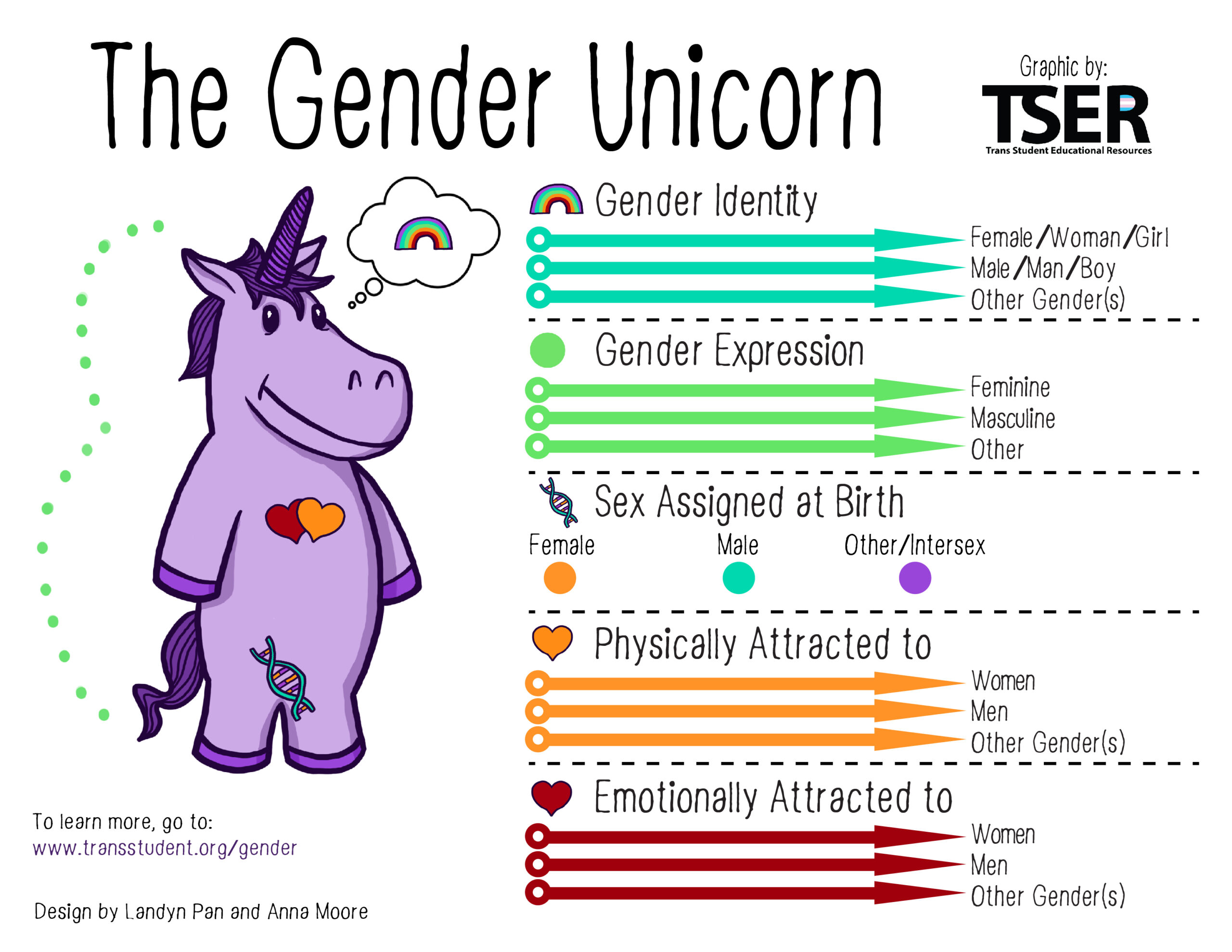
Sex and gender are separate pieces of identity. Gender can be understood primarily through gender expression and gender identity. Gender expression is the presentation of gender through clothing, hair, mannerisms, voice, makeup, etc.. Gender identity is how a person internally experiences and understands their gender.16 Gender expression and gender identity can interact. For example, someone who identifies as male might express their gender by wearing traditionally masculine clothing and getting a short haircut or they may express themselves by painting their nails and wearing make-up — individuals can express their gender in any way that affirms their identity best!
Sometimes someone’s gender identity is different from their biological sex and sometimes it’s the same.
- Cisgender is a term used to describe people whose gender identity is the same as the sex they were assigned at birth.17 For example, a person who was assigned female at birth on the basis of their genitals and identifies as a woman is considered a cisgender woman. However, it is again important to note the distinction between gender identity and gender expression in this context. Gender expression does not always reflect gender identity. For example, this same cisgender woman could present as traditionally masculine, and it would not change her gender identity.
- Transgender is a broad term used to describe people whose gender identity is different from the sex they were assigned at birth.18 Transgender people can identify anywhere along the spectrum of gender identity. This means that transgender people may identify as either male or female, neither male nor female, or as a combination of male and female. People who identify with neither or either gender may use terms such as nonbinary or genderqueer to describe their gender identity.19 In the United States, a Pew Research Center survey found that 1.6 percent of adults are transgender or nonbinary.20
Are Male and Female the Only Sexes?
No. While common narratives have simplified sex into two distinct categories, sex is not just male or female. There are over 40 naturally occurring variations in sex characteristics that get overlooked and ignored when male and female are the only categories considered.21
Sex is often assigned by a doctor at birth based on the appearance of genitals.22 However, biological sex includes factors beyond the appearance of genitals, including sex chromosomes, hormones, and internal sex characteristics. These factors combine to create any variation along the spectrum of biological sex.23 24 Despite this variety, biological sex is often reduced to just two categories: male and female.
Intersex is an umbrella term for variations in sex traits or reproductive anatomy.25 About 1.7 percent of people are born intersex, which is higher than the chance of having identical twins.26 Sometimes, the term “hermaphrodite” is used interchangeably with intersex. However, “hermaphrodite” is considered a slur and should not be used to describe an intersex person.27 People who are born intersex can have any variation across internal and external sex characteristics, chromosomes, or hormones. For example, a person might be born with a vulva but have testes in place of ovaries. There is no one way to look or be intersex, but rather a wide range of different ways that sex anatomy might develop.28 Biological sex does not have a clear demarcation of where the category of male ends and the category of intersex begins, or where intersex ends and female begins. Humans have created these categories and therefore humans decide what “counts” as male, female, or intersex.29
Doctors and nurses will sometimes offer surgery to change natural variations in the appearance of genitals. These surgeries are most often not urgent or life-saving but are rooted in narrow conceptions of the appearance of external genitalia.30 However, these surgeries can result in severe long-term health outcomes, including infertility, chronic pain, and loss of sensation. They can also cause severe emotional and psychological effects, including gender dysphoria, feelings of trauma and shame, and distrust with parents or the medical system.31 Therefore, understanding the natural variation of sex is important for avoiding unnecessary harm and ensuring a safe and inclusive society.
References
1. Johnson Joy L., and Robin Repta. “Sex and Gender: Beyond the Binaries.” In Designing and Conducting Gender, Sex, & Health Research, edited by Oliffe, John L., and Lorraine Greaves, 17-38. Thousand Oaks, CA: SAGE Publications, Inc., 2012. https://doi.org/10.4135/9781452230610.n2.
2. “What is Intersex?” Intersex Society of North America, https://isna.org/faq/what_is_intersex/.
3. “What is Intersex?: Frequently Asked Questions and Intersex Definitions,” InterACT: Advocates for Intersex Youth, January 26, 2021, https://interactadvocates.org/faq/.
4. “Understanding Transgender People: The Basics,” Advocates for Trans Equality, https://transequality.org/issues/resources/understanding-transgender-people-the-basics.
5. IBID
6. Schnebly Risa Aria, “Sex Determination in Humans,” Arizona State University Embryo Project Encyclopedia, July 16, 2021, https://embryo.asu.edu/pages/sex-determination-humans.
7. “Understanding Transgender People: The Basics,” Advocates for Trans Equality, https://transequality.org/issues/resources/understanding-transgender-people-the-basics.
8. Katz-Wise Sabra L., Rosario Margaret, Tsappis Michael. “Lesbian, Gay, Bisexual, and Transgender Youth and Family Acceptance.” Pediatric Clinic North America. 63(6):1011-1025 (2016). doi: 10.1016/j.pcl.2016.07.005.
9. The Trevor Project. “The Trevor Project Research Brief: Data on Transgender Youth,” (2019). Research Brief
10. Katz-Wise Sabra L., Rosario Margaret, Tsappis Michael. “Lesbian, Gay, Bisexual, and Transgender Youth and Family Acceptance.” Pediatric Clinic North America. 63(6):1011-1025 (2016). doi: 10.1016/j.pcl.2016.07.005.
11. IBID
12. Grant, Ruby, Natalie Amos, Teddy Cook, Ashleigh Lin, Adam Hill, Marina Carman, and Adam Bourne. 2024. “From Euphoria to Wellbeing: Correlates of Gender Euphoria and Its Association with Mental Wellbeing among Transgender Adults.” International Journal of Transgender Health 26 (4): 1111–19. doi:10.1080/26895269.2024.2324100.
13. “Understanding Transgender People: The Basics,” Advocates for Trans Equality, https://transequality.org/issues/resources/understanding-transgender-people-the-basics.
14. “Understanding Transgender People: The Basics,” Advocates for Trans Equality, https://transequality.org/issues/resources/understanding-transgender-people-the-basics.
15. IBID
16. IBID
17. IBID
18. IBID
19. “What is Intersex?: Frequently Asked Questions and Intersex Definitions,” InterACT: Advocates for Intersex Youth, January 26, 2021, https://interactadvocates.org/faq/.
20. Brown Anna, “About 5% of young adults in the U.S. say their gender is different from their sex assigned at birth,” Pew Research Center, June 7, 2022, https://www.pewresearch.org/short-reads/2022/06/07/about-5-of-young-adults-in-the-u-s-say-their-gender-is-different-from-their-sex-assigned-at-birth/.
21. “What is Intersex?” Intersex Society of North America, https://isna.org/faq/what_is_intersex/.
22. IBID
23. Schnebly Risa Aria, “Sex Determination in Humans,” Arizona State University Embryo Project Encyclopedia, July 16, 2021, https://embryo.asu.edu/pages/sex-determination-humans.
24. Creighton, Sarah. “Surgery for intersex.” Journal of the Royal Society of Medicine. 94 (5): 218-20 (2001). doi:10.1177/014107680109400505
25. “What is Intersex?” Intersex Society of North America, https://isna.org/faq/what_is_intersex/.
26. IBID
27. IBID
28. “What is Intersex?” Intersex Society of North America, https://isna.org/faq/what_is_intersex/.
29. IBID
30. “What is Intersex?” Intersex Society of North America, https://isna.org/faq/what_is_intersex/.
31. “I Want to Be Like Nature Made Me.” Human Rights Watch, July 25, 2017, https://www.hrw.org/report/2017/07/25/i-want-be-nature-made-me/medically-unnecessary-surgeries-intersex-children-us.
Table of Contents
Let us know how you’re using the information. Just drop us a note at [email protected] and share your experience.
P.S. Don’t forget to credit Fact Checked by Woodhull when citing this work.