
Silencing Sex Workers: What Happens When Sex Workers are Deplatformed?
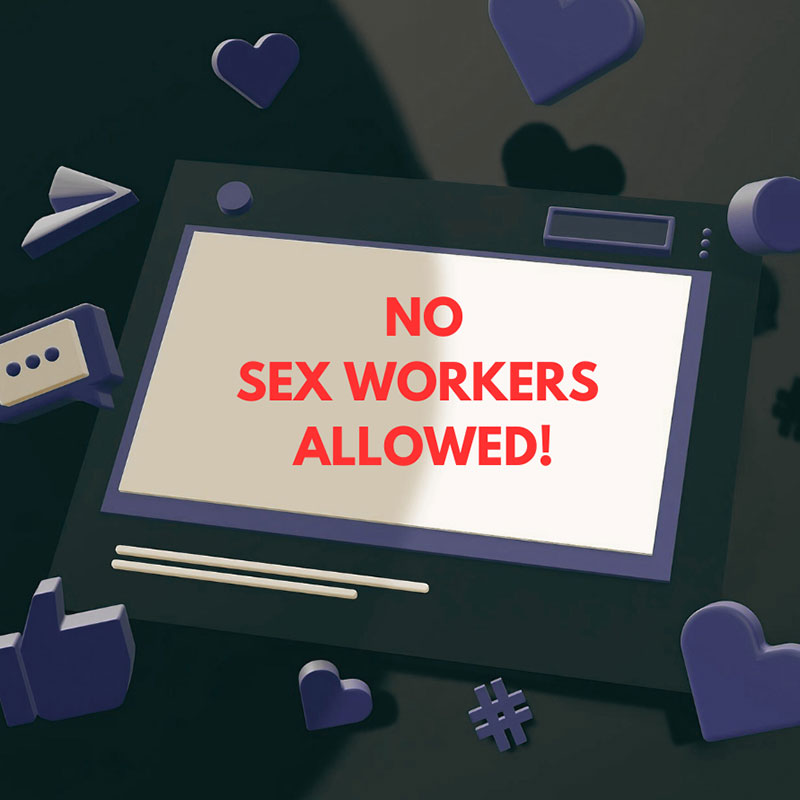
To inform Woodhull Freedom Foundation’s advocacy on sex worker rights and provide the sex worker rights movement with critical data and knowledge on the increasing erasure of sex workers online, we funded a research project on the de-platforming of sex workers. In affirming sexual freedom as a human right, Woodhull fights for sex workers’ bodily autonomy and right to work. To fully enjoy these rights, sex workers must not be censored or banned from online spaces; such infringements erode their freedom to make choices about their bodies, lives, and livelihoods.
This research resulted in the publication of three peer-reviewed articles.
The Process
The research team, led by Dr. Samantha Majic and Dr. Melissa Ditmore at John Jay College at the City University of New York, partnered with two individual sex workers and five sex worker rights organizations, including:
These sex worker advocates and organizations provided invaluable input on the development, design, and implementation of an online survey that 440 sex workers completed, responding to questions about their experiences engaging and negotiating with online platforms. The researchers also interviewed a subset of 40 sex workers who completed the survey.
The research, funded by Woodhull, informs efforts to oppose censorship and erasure and advocate for sex workers’ rights to access digital tools and online spaces. This includes opposing harmful legislation like FOSTA, the Fight Online Sex Trafficking Act, and the Senate bill, SESTA, the Stop Enabling Sex Traffickers Act (collectively known as SESTA/FOSTA), which chills speech and impedes sex workers’ access to online platforms.
 Sex Work and Policing in the United States
Published in the Criminal Justice Review
Building on the larger mixed-method project on sex workers’ experiences with online platforms in the post-SESTA-FOSTA era in the United States, this paper examines sex worker-police interactions in the U.S.
It addresses two research questions:
What types of interactions do sex workers have with police, and how frequently do these interactions occur?
Is there an association between legal status of sex work and type of police interactions?
Results suggest that sex workers frequently interact with law enforcement, with interactions predominantly reported as multiple and negative, followed by positive and neutral interactions. Moreover, participants’ type of sex work at the time they completed the survey explains the variation in these interactions. The findings support the decriminalization of sex work, the removal of punitive laws, and the implementation of tailored harm reduction strategies.
 440 Sex Workers Cannot Be Wrong: Engaging and Negotiating Online Platform Power
Published in the journal Social Sciences
This article specifically expands existing research on platform power by answering the following questions:
- How and to what extent do sex workers engage with online platforms?
- How do these platforms’ policies and practices shape the conditions of their work?
- How do sex workers negotiate these platforms’ power?
 Sex Workers, Online Platforms, and Deplatforming: A Case of Policy Feedback?
Published in the journal New Political Science
- advocate for themselves by interacting with platforms,
- navigate their restrictions to continue working and maintain peer contact (user effects), and
- share organizational, legal, and policy-related information and calls to action, despite risks accompanying these activities (political effects).
 Re-thinking Vulnerability: Research fraud and bureaucratic harm in community-engaged online research
Published in the journal Qualitative Research
This article also emerged from the research we funded, and it documents the research team’s experiences carrying out the survey and interviews for this project. This article provides new insights about how university bureaucratic practices and research fraud may harm both study participants and researchers by undermining community collaborations, data collection, and researcher safety and well-being.
This article also provides guidance for future sex work-related research projects, offering insights about:
- Navigating university bureaucracies
- Administering surveys online to capture the diversity of the sex worker community, including but not limited to its members’ racial and ethnic backgrounds, immigration status, education, income, disability, gender, and sexuality