Woodhull Watchlist: Supreme Court Term 2026-2027
October 26, 2026
On Monday, October 5, 2026, the US Supreme Court began hearing cases scheduled for the 2026-2027 term. Woodhull Freedom Foundation is closely watching several cases that impact free speech, LGBTQIA+ rights, and gender justice. These cases are part of what is known as the “merits docket”, which means each case includes a deliberative process involving:
- Oral arguments before the Justices
- Full briefing from parties involved in the case
- Possible “friends of the court” briefings for parties not involved in the case, but who wish to provide additional information for the Court to consider
- Signed opinions by the Court, including transparency on how each Justice voted
SCOTUS Merits Docket
St. Mary Catholic Parish v. Roy
- Issues:
- Religious liberty, LGBTQIA+ rights
- Question Presented:
- Does a law fail to be generally applicable only if it gives the government “unfettered discretion” to grant individualized exemptions, or if it explicitly provides secular exemptions while denying religious ones?
-
- Does the constitutional prohibition against excluding religious institutions from public funding apply only when the state enacts an explicit, direct ban on religious participation, or does it also apply when a religious school is denied funds because it refuses to comply with a neutral, generally applicable conduct or nondiscrimination condition?
- Case Background:
- This case relates to a Colorado proposition that residents approved by vote in 2020. The proposition created a dedicated funding source in the state for voluntary, universal preschool in Colorado. In 2022, the state created a related-Universal Prep-K Program that conditioned participation on compliance with an “equal opportunity” requirement that, in part, protected LGBTQ+ children and families against discriminated when participating in the Program.
-
- Two Catholic parishes that run preschools subsequently challenged the “equal opportunity” requirement, alleging it violated their First Amendment protected free exercise rights. In this case, the Supreme Court is evaluating whether the state can condition taxpayer funded financial support on adherence to nondiscrimination policies that protect LGBTQ+ youth and families. If the Supreme Court rules in favor of Colorado, it will reinforce that public funds cannot be applied towards public programs that discriminate against LGBTQ+ individuals. A ruling in favor of the Catholic parishes could create broad religious exemptions, giving faith-based organizations access to taxpayer money while denying services to LGBTQ+ families or youth.
-
- The ACLU of Colorado and allied organizations filed an amicus brief (“friend of the court” brief) in support of Colorado’s Opposition Brief. For further details on the case and the amicus brief filed by ACLU of Colorado, read their case analysis, here. We also recommend the Williams Institute’s case summary, available here.
- Date of Oral Arguments:
- November 3, 2026
- Updates on Proceedings and Filings:
- Woodhull Position:
- Woodhull is aligned with the ACLU of Colorado and the other civil rights organizations that co-authored their amicus brief in favor of the State of Colorado. In it, they argue there is, “no Free Exercise Clause violation when a governmental body conditions a public benefit on a religion-neutral and generally applicable requirement.” We therefore implore the Supreme Court to rule in favor of the State of Colorado and thus in favor of protecting LGBTQIA+ children and families’ access to publicly funded preschools without discrimination. A Supreme Court ruling allowing St. Mary’s Catholic Parish to access taxpayer funds without adhering to Colorado’s nondiscrimination policy permits state-sanctioned stigma against LGBTQIA+ children and families.
-
- Learn more about the importance of robust laws and policies to protect the safety and well-being of LGBTQIA+ young people in our Fact Checked by Woodhull Series on Sexual Orientation and Transgender and Gender Non-Conformity.
- Analysis of Oral Arguments:
- Forthcoming
- Woodhull Statement on Oral Arguments:
- Forthcoming
- Woodhull Statement on SCOTUS Ruling:
- Forthcoming
International Partners for Ethical Care, Inc. v. Ferguson
- Issues:
- LGBTQIA+ rights, gender-affirming care, parental rights
- Question Presented:
- Do parents have constitutional standing to challenge a law or policy that deliberately displaces their decision-making role related to their child receiving gender-affirming care, and if in doing so, does the law or policy create present or likely future impediments to the parent’s ability to parent their child as they deem best for the child?
- Case Background:
- In this case, the plaintiffs represent parents and family-rights groups challenging Washington State laws that allow licensed youth shelters and homes to protect the identity of minors for up to 72 hours if they have runaway and are receiving shelter while seeking or receiving gender-affirming or reproductive healthcare or mental health services without notifying their parents immediately.
- The plaintiffs in the case are specifically challenging the U.S. Court of Appeals for the Ninth Circuit’s prior ruling that denied the plaintiff’s standing in the case because they did not establish a viable injury. In other words, the plaintiffs did not make a successful argument to the court demonstrating that the Washington State laws caused them a legally defined current injury by constraining their parenting style or limiting their access to information or potential future injury if a child was to run away and access shelter-provided services that may relate to gender-affirming care.
- The case is not about ruling on youth’s access to gender-affirming care itself but is rather about Article 3 in the Constitution, which relates to whether a party in a lawsuit has the right to have their case decided by a federal court.
- Date of Oral Arguments:
- December 7, 2026
- Updates on Proceedings and Filings:
- Woodhull Position:
- At Woodhull, we recognize that while this case is about the plaintiffs’ Article 3 Constitutional standing to challenge state laws or policies, that it also brings in questions of LGBTQIA+ youth’s safety and access to critical gender-affirming and reproductive healthcare. We are concerned that if SCOTUS rules in favor of the plaintiffs and provides them with Article 3 standing to challenge state-level laws such as those in question in Washington State, that it will open the floodgates for similar cases throughout the United States. This could mean challenges of youth shelter nondisclosure rules, and public-school policies that protect LGBTQIA+ youth in shelter and educational settings from being forced to disclose their gender or sexual identity to their parents. We are deeply concerned with how this could endanger LGBTQIA+ youth throughout the country. We therefore implore the Supreme Court to recognize the lower court rulings in this case and determine that the plaintiffs have not satisfactorily demonstrated standing to challenge the state-level laws.
- Analysis of Oral Arguments:
- Forthcoming
- Woodhull Statement on Oral Arguments:
- Forthcoming
- Woodhull Statement on SCOTUS Ruling:
- Forthcoming
SCOTUS Shadow Docket
Woodhull follows the cases the Supreme Court hears in full, and we also watch its emergency docket, often called the “shadow docket.” During both of President Trump’s terms, his administration has used it more and more often to get the Court to rule quickly on very serious questions, with little public scrutiny. Shadow docket cases have no oral arguments, and the Justices aren’t required to explain their reasoning or say how each of them voted. The administration’s reliance on the shadow docket, and the Court’s willingness to make major decisions this way, is deeply disturbing and sets a dangerous precedent.
At the beginning of the term for 2026-2027, Woodhull is monitoring two shadow docket cases.
KMK, By Her Next Friend and Mother, Stephanie Lynne Brown, Applicants v. Washington Interscholastic Activities Association, et al.:
- In this case, a Washington state teenager and her mother have asked the Supreme Court to take emergency action to prevent transgender athletes from participating in girls’ school sports. This is the first case on transgender students’ access to school sports aligned with their gender since SCOTUS’s 2026 ruling upheld state bans against transgender girls participating in girls’ sports. In the case, SCOTUS is being asked to go further than their prior ruling and consider whether states should be required to ban transgender girls from participating in girls’ sports.
- See further details on the case, here. As the case proceeds, we will provide updates to this blog.
Donald J. Trump, President of the United States, et al., Applicants v. Alishea Sophia Kingdom, et al.:
- In this case, three transgender people incarcerated in US federal custody challenged the Trump Administration’s Executive Order and the Federal Bureau of Prison’s (BOP) new policy prohibiting their access to gender-affirming care. This is a class action lawsuit, meaning the complainants filed it on behalf of approximately 2,000 transgender people incarcerated in US federal prisons throughout the country. The plaintiffs in the case are represented by the ACLU, the ACLU of DC, and the Transgender Law Center.
- On October 21, 2026, the Supreme Court ruled that the Trump Administration and BOP must keep in place a temporary order that requires prison officials to provide transgender people access to gender-affirming care while incarcerated in federal prisons. In the ruling, only Justices Clarence Thomas and Sam Alito stated that they would have granted the Trump administration’s request to enforce the policy blocking access to gender-affirming care. This is a critical ruling to protect transgender people’s rights in accessing life-saving healthcare while imprisoned. However, this is only a temporary victory, as the order banning the implementation of the Trump and BOP policy expires in December, unless the lower court renews it. See further details on the case and SCOTUS ruling, here.
Review our Woodhull Watchlist: SCOTUS Term 2025-2026, here.
To stay up to date on all our work to defend and protect sexual freedom as a fundamental human right, follow us on social media:
Resources
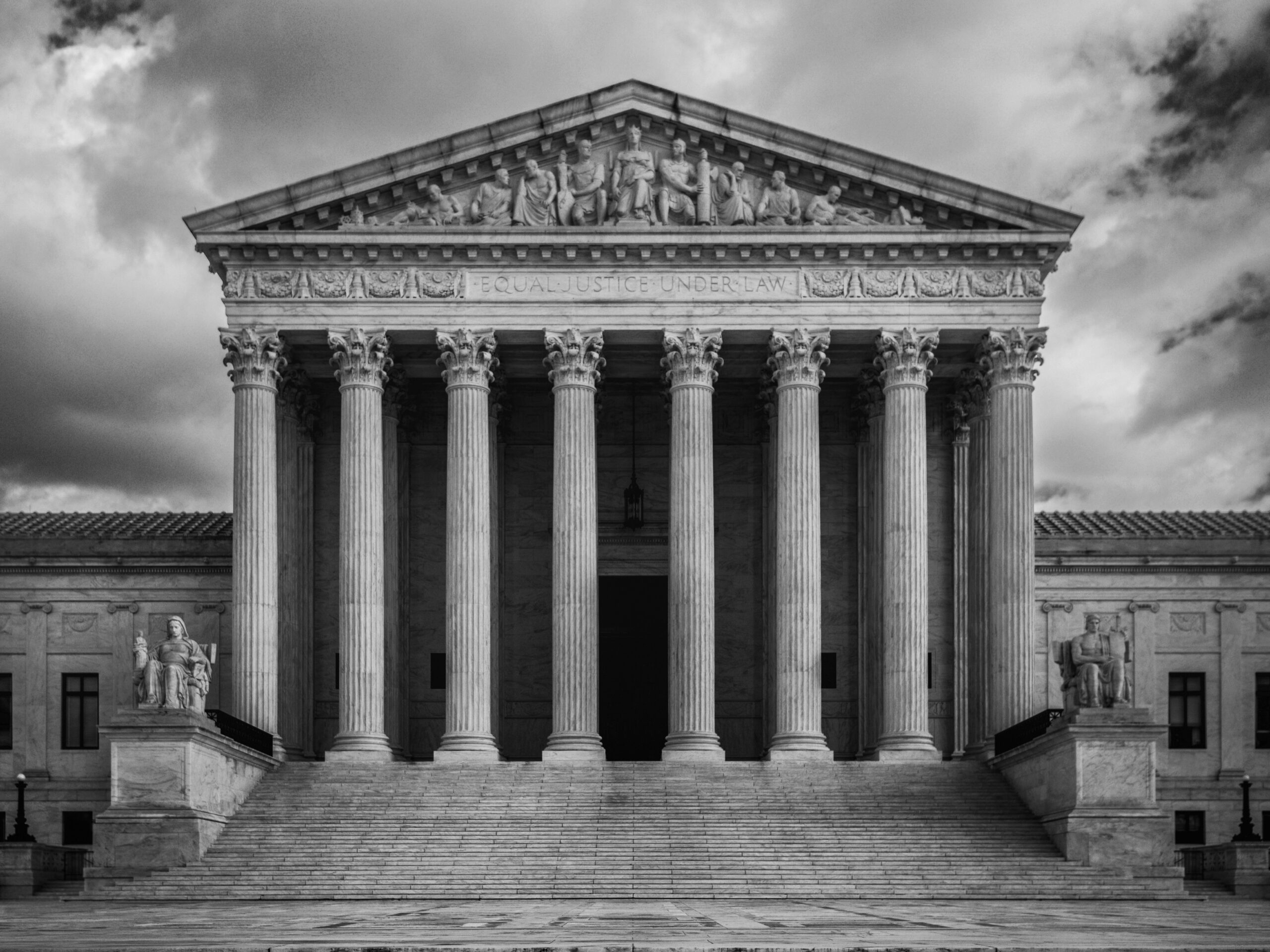
A black and white photo of the Supreme Court building in Washington, DC. (Photo by Tim Mossholder via Unsplash)